COBB FIBRE OTTICHE

How we manufacture our fiber optic lighting systems (and why they are better)

Cobb Fibre Ottiche | How we manufacture our fiber optic lighting systems (and why they are better)

In the world of fiber optic lighting, quality doesn’t depend only on the final result, but above all on how each individual component is made.

This is exactly where the difference between a standard system and a truly high-performance one is created.

In this article, we take you inside our production process to clearly explain why our systems deliver superior performance.


1. The core of the system: the fiber optic connector

One of the most important — and often underestimated — elements is the connector that links the fiber optics to the light source.

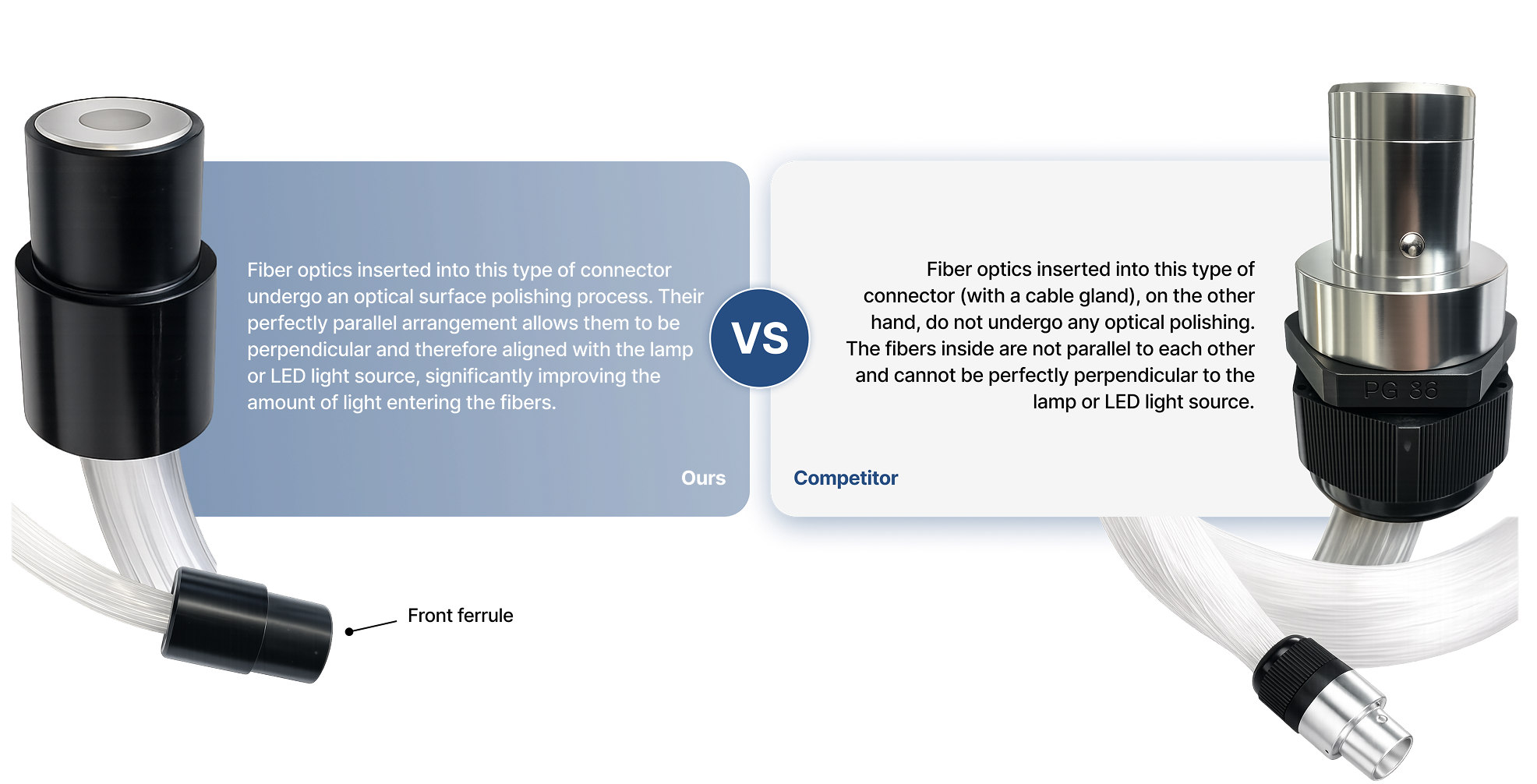
In traditional systems, this connection is typically made using simple cable glands.
A seemingly functional solution, but one that comes with several limitations:

  • fibers are not perfectly aligned
  • they are not parallel to each other
  • they are not perpendicular to the light source
  • no optical polishing is applied

All of this leads to a direct consequence:
a loss of brightness that can reach up to 20–30% .


2. Our solution: front aluminum ferrule

To overcome these limitations, we have developed a completely different system.

The fiber optics are inserted into a front aluminum ferrule and secured through a precise mechanical process using dedicated machinery.

This allows us to achieve:

  • perfectly compacted fibers
  • parallel alignment across all fibers
  • perpendicular orientation to the light source
  • stable fixation, even under torsion or mechanical stress

The result is a far more efficient and consistent light transmission over time.


3. Optical polishing: a crucial step

Once secured, the fibers undergo a two-step optical polishing process:

  • first pass with 400-micron abrasive
  • finishing with 800-micron abrasive

This process creates a perfectly flat and uniform surface.

Why does it matter?

Because a smooth surface:

  • improves light entry
  • reduces unwanted reflections
  • enhances overall light performance

On the contrary, an irregular surface causes light dispersion and loss.


4. Fiber optics: material quality makes the difference

Not all fiber optics are the same, even if they may look identical at first glance.

Our “FB” synthetic fibers are made with:

  • PMMA core (polymethyl methacrylate)
  • fluorinated polymer cladding
  • numerical aperture of 0.5
  • attenuation lower than 200 dB at 650 nm

These characteristics ensure:

  • better light transmission
  • more accurate color rendering
  • long-term performance stability

Beware of low-quality fibers

Many fibers on the market, although declared as PMMA, actually contain polycarbonate.

This results in:

  • higher fragility (they break more easily)
  • attenuation above 300 dB
  • altered light color output

As a consequence, lighting quality is compromised from the very beginning.

[/vc_column_text]

Cobb Fibre Ottiche | image 1298 |

5. LED illuminators: performance and control

The system is completed by the illuminators, designed to offer efficiency, reliability, and maximum control flexibility.

With a single illuminator, you can choose different control methods:

  • wall switch (on/off, dimmer, RGB)
  • RF remote control
  • touch panel
  • smartphone or tablet
  • voice assistants (Alexa, Google Assistant)
  • professional systems (DMX, DALI, Casambi)

This makes the system adaptable to any environment, from residential to professional applications.


6. Efficiency and long-term reliability

Our 4W, 9W, and 12W illuminators are designed to guarantee:

  • low energy consumption
  • high light output
  • up to 50,000 hours lifespan
  • silent operation (fanless systems)

At the core of this performance is a dedicated optical design, engineered to focus light precisely into the connector and, therefore, into the fibers.

[/vc_column][/vc_row]
Cobb Fibre Ottiche | image 1245 |

7. Applications: where quality truly matters

This technology is used across a wide range of applications where precision and light performance are essential:

  • residential star ceilings
  • swimming pools
  • wellness centers and spas
  • museum lighting
  • marine applications
  • custom projects

Each application demands reliability, consistency, and high-quality light output.


Conclusion

A fiber optic lighting system is not just a collection of components, but the result of a precise design and manufacturing process.

The difference is built through:

  • accurate mechanical engineering
  • professional optical treatments
  • carefully selected materials
  • advanced control technologies

It is the combination of these elements that allows our systems to deliver:

✨ higher brightness
✨ longer lifespan
✨ greater reliability